
See the journey · original visual explanations
Your enterprise. In context. Ready for its next step.
Explore how discovery connects strategy, shared meaning and accountable action. Keep your core strengths, understand your existing stack and choose suitable technology for the work ahead.
Illustrative explanations, not a live AI assessment. These original diagrams and animated explainers describe the proposed Contextual Discovery Lens and CAE approach. They do not depict a customer, connected enterprise, measured result or autonomous product running in this website. No organisation data is collected or analysed by these visuals.
1. From fragmented enterprise to shared context
The starting point is a typical mix of legacy applications, cloud platforms, digital products, teams and local knowledge. Discovery establishes the business question and permitted evidence. A reviewed contextual model connects meaning, relationships, provenance and authority before any agent is allowed to act.
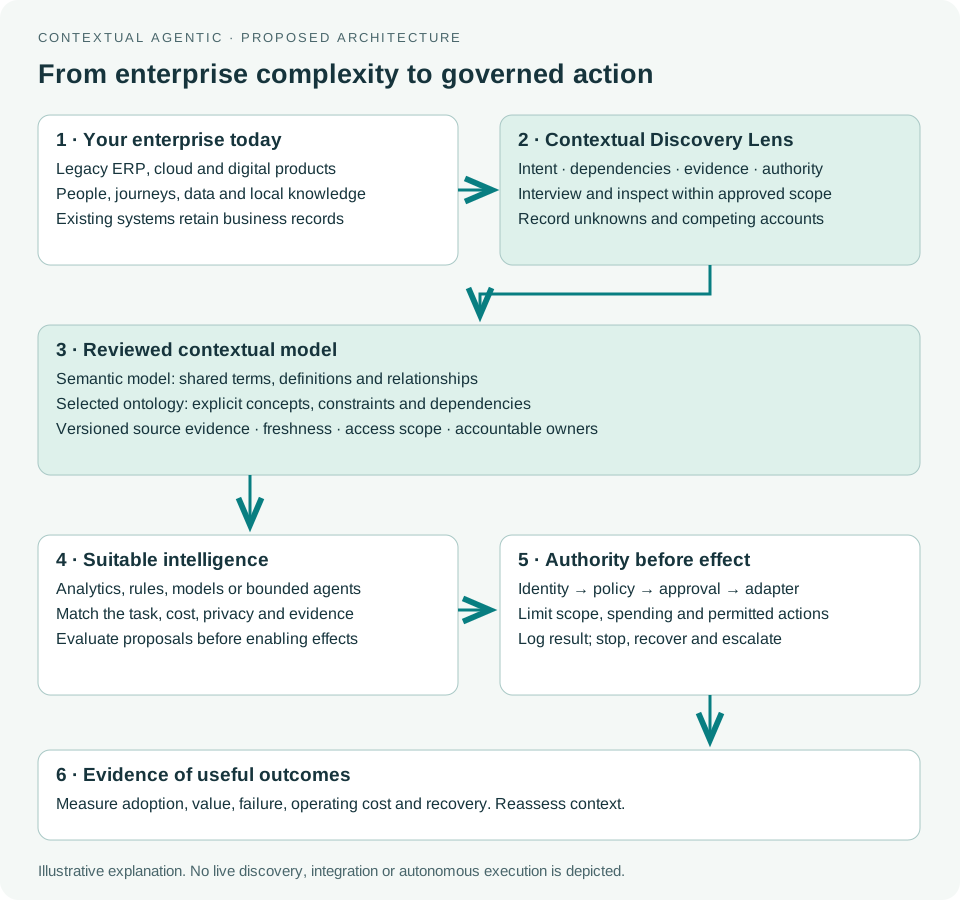
Watch: contextualise your enterprise
Read the contextual enterprise transcript
An enterprise contains people, processes, legacy systems, cloud platforms and data. The Contextual Discovery Lens starts with business intent and examines dependencies, evidence and authority. A reviewed contextual model makes shared meaning explicit through concepts, relationships, provenance and ownership. Suitable analytics, automation or AI can then support a bounded workflow. Consequential actions still require identity, policy, approval where needed and an authorised adapter. Measure the result and update context as the enterprise changes. This is an illustrative architecture, not a live discovery engine.
Explore the six-stage interactive model or read the discovery method.
2. Enterprise health and responsible AI readiness
Investing in more technology can leave architectural constraints unresolved. Slow adoption, duplicate capabilities, inconsistent customer journeys and invisible dependencies are signals to investigate. A health check connects those symptoms to evidence across eight dimensions, then sets a scoped strategy and next actions.
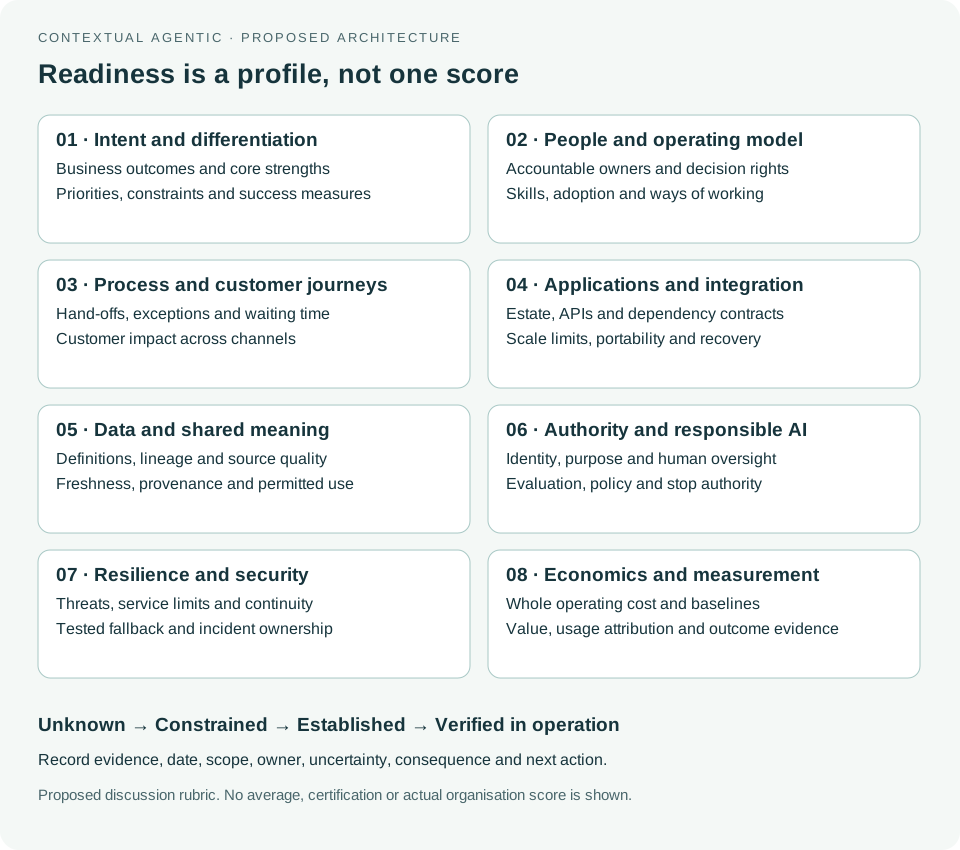
Watch: from health signals to strategy
Read the health-to-strategy transcript
Cloud, AI and digital investment do not by themselves remove architectural constraints. Start with the signals: slow adoption, duplicated capabilities, fragmented journeys and unclear dependencies. Review eight dimensions: business intent and differentiation; people and operating model; process and customer journeys; applications and integration; data and shared meaning; authority and responsible AI; resilience and security; delivery economics and measurement. Record evidence, scope, owner and uncertainty. Treat missing evidence as unknown, rather than inventing a score. Use the findings to prioritise strategy, contextualisation and one useful delivery increment. The proposed health check does not certify compliance or guarantee a business result.
Explore the enterprise health check.
3. Use your stack. Preserve what makes you competitive.
Technology should serve the organisation’s strategy. Retain useful platforms and differentiating capabilities, make integration contracts and shared meaning explicit, then introduce new capabilities where their value can be evaluated. Enterprise-wide context can develop incrementally around important workflows.
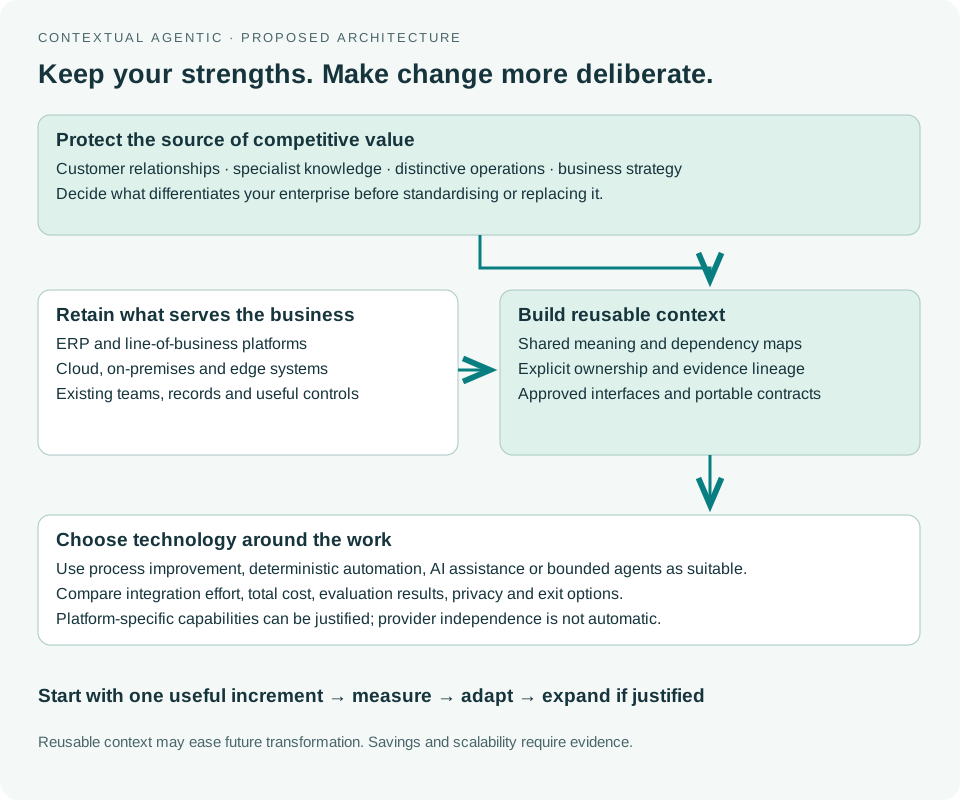
Watch: governed delivery around your enterprise
Read the governed-delivery transcript
Begin with the capabilities that make your organisation competitive. Preserve useful systems and business records. Build reusable context with shared definitions, evidence lineage, owners and approved interfaces. Choose process improvement, fixed automation, AI assistance or bounded agents for the actual task. Before an action, check identity, policy, scope and required approval. Execute through an authorised adapter, record the result and provide a stop and recovery path. Measure value and operating cost before expanding. Platform independence is not automatic, and future savings must be demonstrated.
Apply the idea to your organisation
The direction is discovery → strategy → contextualisation → governed delivery → reassessment. Start with a business question and a bounded workflow. Agree evidence access, owners, scope and acceptance criteria before gathering enterprise information or connecting technology.
Discuss your enterprise and access options · Explore the CAE capability architecture · Review capability status.
YOUR ENTERPRISE. YOUR NEXT CHAPTER.
Turn complexity into
a clear next move.
Bring a business question. We can discuss a discovery scope and the decisions it should support.
Start a discovery conversation